
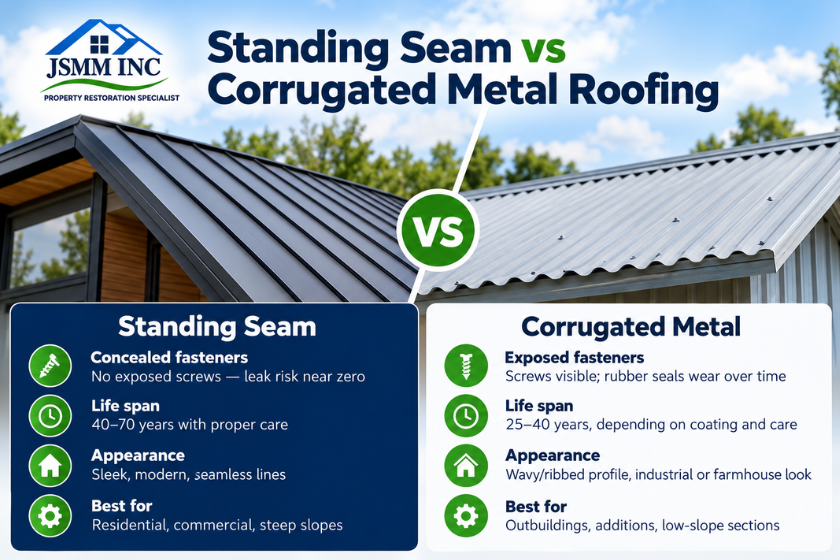
Standing seam metal roofing uses concealed fasteners and smooth vertical panels that lock together at raised seams, giving a clean modern look and near-zero leak risk. Corrugated metal uses exposed screws through a wavy or ribbed sheet — lower cost, simpler installation, but a shorter lifespan and more maintenance over time. For a primary residence, standing seam is usually the better long-term choice. For outbuildings, sheds, and budget-sensitive projects, corrugated metal can make good sense.
Both are metal roofing. That is where the similarity ends. The system you choose affects how long the roof lasts, what it costs to maintain, how it looks, and whether it suits your home’s structure.
If you are still deciding whether metal roofing is right for your home at all, our guide on metal roof vs shingles covers that comparison first.
Table of Contents
ToggleConsidering metal roofing for your home?y?
Contact JSMM Inc. for a free estimate. We install both standing seam and corrugated systems across the North Shore and help you choose the right one.
What Is Standing Seam Metal Roofing?
Standing seam is a metal roofing system where long, vertical panels run from the ridge of the roof to the eaves. Each panel locks into the next at a raised seam, which sits above the flat surface of the roof.
The key feature is the fastening method. The panels attach to the roof deck with hidden clips, not screws through the surface. This means there are no exposed fasteners anywhere on the finished roof.
That distinction matters. Every exposed screw on a roof is a potential leak point. The rubber washers around the screws degrade over time, crack, and let water in. Standing seam eliminates that risk entirely.
The panels also float on the clips rather than being rigidly attached, which allows the metal to expand and contract with temperature changes. Illinois weather — hot summers, cold winters — puts significant stress on roofing systems. The standing seam handles thermal movement better than any other metal option.
What Is Corrugated Metal Roofing?
Corrugated metal is the older, simpler form of metal roofing. The sheets are formed into a repeating wave or rib pattern, which adds strength to what would otherwise be a thin flat sheet.
It is installed with exposed fasteners — screws that go through the face of the sheet, through the underlayment, and into the deck or purlins below. This makes installation faster and cheaper, but those fasteners need attention over time.
Corrugated metal has been used on agricultural and industrial buildings for well over a century. In recent years it has also become popular on farmhouse-style homes, porches, additions, and outbuildings where the industrial look fits the design.
On homes that already have standard asphalt shingles, the decision to move to any metal system is also partly about when a roof replacement makes sense in the first place.
Standing Seam vs Corrugated: The Full Comparison
Here is how the two systems compare across every factor that matters for a homeowner.
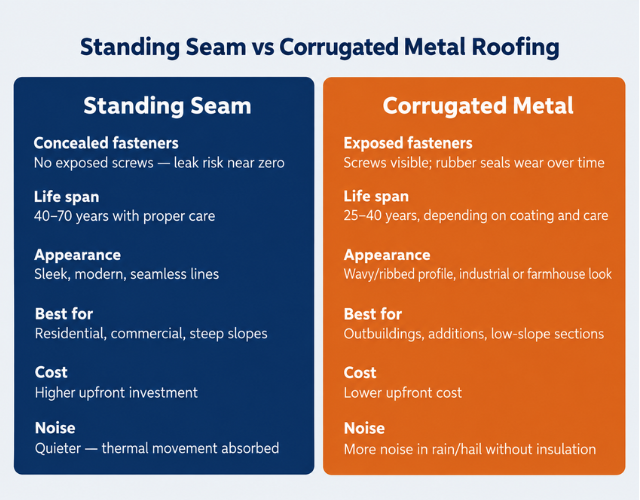
The lifespan gap is the most important number. A standing seam roof installed correctly can last 40 to 70 years with almost no active maintenance beyond the occasional inspection. Corrugated metal lasts 25 to 40 years and requires periodic checks on the fastener seals — more often as the roof ages.
On cost, corrugated metal typically comes in 30% to 50% lower than standing seam for the same square footage, mostly because the panels are cheaper to make and faster to install.
How Do They Look on a Residential Roof?
Appearance is often the deciding factor for homeowners on the North Shore, where curb appeal carries real weight.
Standing Seam
Standing seam has a sleek, minimal look. The raised seams create clean vertical lines across the roof with no visible hardware. On a modern home or a traditional home updated with a premium roof, it looks intentional and polished. From the street, the roof looks like a solid, well-engineered surface.
Corrugated Metal
Corrugated metal has a more textured, industrial profile. The wave pattern is visible from any distance. On a farmhouse-style home or a utility structure, it reads as a deliberate design choice. On a traditional colonial or brick Tudor, it can look out of place unless the designer has planned around it carefully.
Neither look is wrong — but it is worth seeing both in person on homes in the area before you commit.
Which Performs Better in Illinois Weather?
Illinois roofs face a genuine range: heat and humidity in summer, hard freezes and heavy snow in winter, hail in spring. Metal handles all of these better than asphalt, but standing seam handles them better than corrugated.
In winter, both systems shed snow effectively because the smooth surface offers little grip. But standing seam’s floating panel system prevents the stress cracking and seal failures that corrugated systems can develop through freeze-thaw cycling.
For comparison, standard asphalt shingles typically last 20 to 30 years in an Illinois climate. Even corrugated metal outlasts them by a meaningful margin. Standing seam outlasts both.
Good attic ventilation matters with both metal systems. Heat trapped in the attic can cause condensation on the underside of metal panels, which leads to premature corrosion if ventilation is poor.
What Does Each System Cost?
Metal roofing in general costs more upfront than asphalt shingles, but the gap between standing seam and corrugated is real and worth understanding.
Corrugated metal is the more budget-friendly choice — simpler panels, faster installation, widely available material. It is a sensible option for outbuildings, porches, and secondary structures where longevity is valued but appearance is less critical.
Standing seam carries a higher upfront cost because the panels are custom-formed, installation is more precise, and the concealed clip system adds material cost. But over 50 years, the maintenance savings and the longer service life often make it the lower total-cost option.
Our guide on new roof costs in Illinois puts the cost of any roofing system in context. If the upfront cost is the barrier, our roof financing options can make a standing seam roof accessible without a large cash outlay.
Which One Should You Choose?
There is no single right answer — it depends on the structure, the budget, and the priorities.
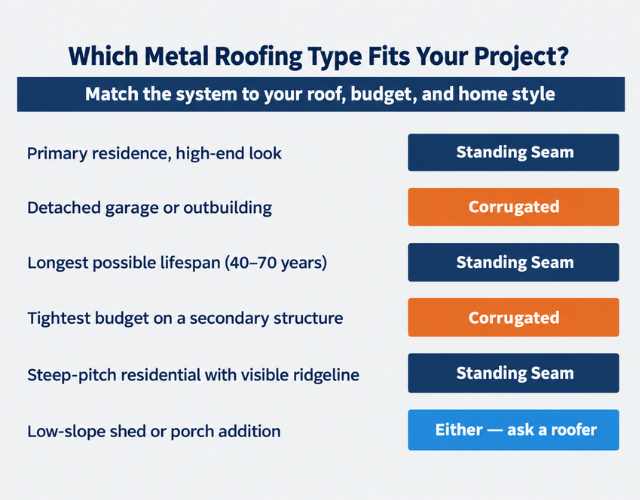
For a primary residence where the roof will be visible from the street and you want it to last several decades with minimal maintenance, standing seam is the clear choice. The concealed fasteners, the thermal float system, and the longer lifespan are worth the extra investment.
For a detached garage, barn, shed, or porch where the roof will see less scrutiny and the budget is tighter, corrugated metal is a solid option. It still outperforms asphalt in most respects and costs less to replace when the time comes.
If you are not sure whether you need a full replacement or can get more years from your existing roof, our guide on repair versus replacement provides a clear framework for making that decision.
Frequently Asked Questions
What is the difference between standing seam and corrugated metal roofing?
Standing seam uses concealed fasteners and smooth vertical panels that lock at raised seams. Corrugated metal uses exposed screws through a wavy or ribbed sheet. Standing seam has a longer lifespan and near-zero leak risk but costs more. Corrugated costs less and suits outbuildings and budget projects.
How long does standing seam metal roofing last?
A properly installed standing seam roof lasts 40 to 70 years. The concealed fasteners, floating panel system, and quality coatings make it one of the longest-lasting residential roofing systems available.
How long does corrugated metal roofing last?
Typically 25 to 40 years, depending on the coating type and how well the fastener seals are maintained. The exposed screws need periodic inspection, and failing seals are the most common source of leaks on corrugated roofs.
Can I put standing seam or corrugated metal over my existing shingles?
It is possible in some cases, but we recommend a full tear-off for both systems. The deck condition needs to be inspected before any metal is installed. A professional roof inspection confirms whether the deck is sound enough to carry a new roof.
Which is better for Illinois winters — standing seam or corrugated?
Standing seam handles Illinois weather better. The floating panel system accommodates the expansion and contraction caused by freeze-thaw cycles, and the absence of exposed fasteners eliminates the most common winter leak point on corrugated roofs.
Does JSMM Inc. install both types of metal roofing?
Yes. JSMM Inc. installs both standing seam and corrugated metal roofing systems for residential properties across the North Shore. Our Illinois roof replacement service covers both systems with manufacturer-certified installation and a written, itemized estimate. Our roofing warranties page explains the coverage that comes with each.
Ready to get a clear, written estimate on a metal roof?
Contact JSMM Inc. or call (847) 410-7060. We cover Highland Park, Winnetka, Northbrook, and the full North Shore with no-pressure, honest advice.