


A ridge vent runs along the peak of the roof and gives even airflow across the whole attic. Box vents and other roof vents are fixed at single spots and cover smaller areas. For most homes, a ridge vent paired with soffit vents is the best system, because it moves air evenly from bottom to top without any moving parts.
The type you choose affects how long your roof lasts, how much moisture collects in the attic, and whether ice dams form in winter. It is a bigger decision than most homeowners realize.
This guide breaks down each type and helps you pick. If you want to understand why attic airflow matters before choosing, our full guide on why roof ventilation matters is the right starting point.
Table of Contents
ToggleWhy Roof Vents Matter in the First Place
Before comparing types, it helps to understand the job. A roof vent does one thing: let hot, moist air escape the attic.
In summer, attic heat builds to extreme levels without ventilation. That heat bakes the shingles from below and forces the air conditioner to work harder. In winter, warm air from the living space rises into the attic, hits the cold roof deck, and turns to moisture.
That moisture soaks into the roof decking and insulation, causing rot and mold that can spread silently for years before anyone notices it. Eventually it shows up as stains on the ceiling below.
What Are the Different Types of Roof Vents?
There are four main types. Each has a different design, a different cost, and a different effectiveness.
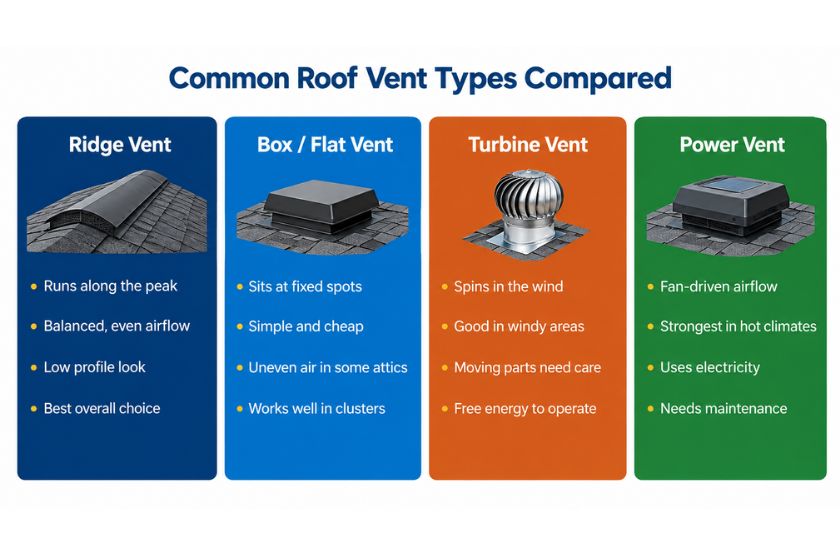
Ridge vents run the length of the roof peak. Box vents sit at fixed points on the roof surface. Turbine vents spin in the wind. Power vents use a fan driven by electricity or solar. Each moves air differently, and not all work equally well on every home.
What Is a Ridge Vent and How Does It Work?
A ridge vent is a long, low-profile slot cut along the peak of the roof. A cover strip sits over it to keep rain and debris out, while still allowing air to escape freely.
It works by natural convection. Cooler air enters the attic through soffit vents at the eaves, rises as it warms, and exits through the ridge vent at the peak. This creates a steady, passive flow with no moving parts and no electricity needed to run it.
That simplicity is its biggest strength. Nothing to maintain, nothing to fail, and the airflow is even across the whole attic rather than concentrated at one spot.
A ridge vent needs soffit vents to work. Without an intake at the bottom, there is nothing to replace the air leaving at the top. The two work as a pair: cool air in through the soffit, warm moist air out through the ridge.
What Are Box Vents, Turbines, and Power Vents?
These are the alternatives. They each have a case for the right situation.
Box or flat vents are simple square or round caps placed at specific spots on the roof. They are cheap and effective but only ventilate the area near them. Most attics need several to cover the space well.
Turbine vents spin in the wind and pull air out as they turn. They work well in windy areas but have moving parts that can wear out or seize. A stuck turbine becomes a gap in the roof.
Power vents use an electric fan to force air out. They are the most powerful option but use electricity and need maintenance. Solar-powered versions avoid the running cost but still have more moving parts than passive types.
Ridge Vent vs Box Vents: The Key Differences
Most homes come down to this choice. Here is how the two compare side by side.
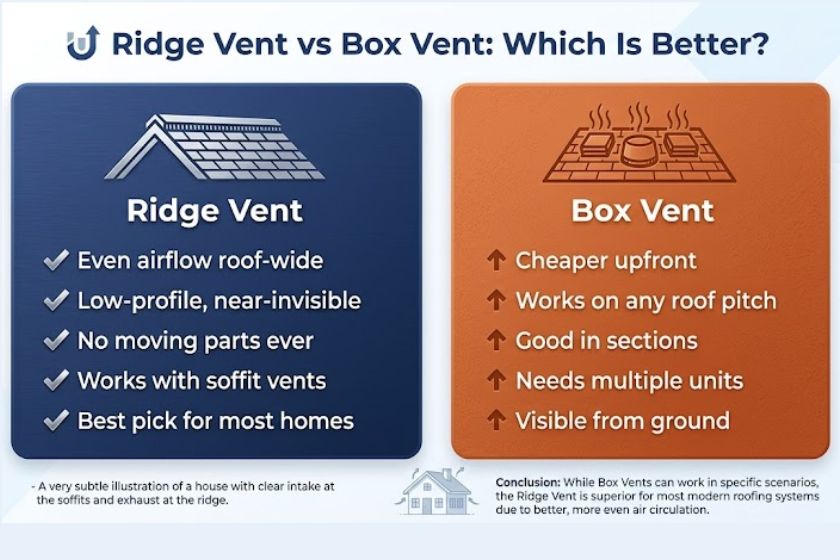
Ridge vents win on even airflow, low maintenance, and appearance. Box vents win on upfront cost and on roofs where a ridge vent is not possible, such as very low-slope or complex shapes. For a standard pitched roof, a ridge vent is the better long-term choice.
Which Vent Type Is Actually Better?
For most homes with a standard pitched roof, a ridge vent paired with soffit vents is the best system. It is passive, balanced, and requires no maintenance.
Box vents are a reasonable alternative when a ridge vent is not practical, or as a budget-friendly option when placed in enough quantity to cover the attic. Turbine and power vents suit specific situations, like very hot climates or attics with unusual layouts where passive venting simply cannot move enough air.
Whatever system is chosen, it needs to work with the soffit. Soffit vents bring air in at the bottom; ridge or roof vents let it out at the top. Our soffit and fascia guide covers that intake side. Good ventilation also shields the asphalt shingles from heat damage below.
Can You Mix Ridge Vents and Box Vents?
No. Mixing them on the same attic space almost always causes problems. When a ridge vent and a box vent are both open in the same attic, air short-circuits between them.
Instead of moving through the whole attic from soffit to peak, air takes the short path from the box vent to the nearby ridge vent and exits. The rest of the attic stays stagnant, which is worse than having no extra vents at all.
If you have both types on your roof, a roofer can assess which is doing the real work and whether the other should be removed or capped.
Which Vent Works Best in an Illinois Climate?
Illinois puts attic ventilation under real pressure in both directions: hot, humid summers and cold, icy winters.
A ridge vent handles both seasons well. In summer, it pulls heat out continuously. In winter, even airflow prevents the warm patches that cause ice dams at the eaves. Our guide on how to prevent ice dams explains how ventilation fits into the full cold-weather plan.
Heavy snow is another concern. Our guide on safe snow load and removal covers what to watch for in winter, and a well-ventilated attic makes your roof safer in those conditions.
What Happens When Ventilation Is Blocked or Insufficient?
A vent is only useful if air can move through it. Blocked soffit vents, damaged ridge vents, or too few box vents all produce the same result: stale, hot, moist air sitting in the attic.
In summer, that trapped heat accelerates shingle aging from below. In winter, warm patches on the roof create freeze-thaw cycles that crack and lift shingles over time. And year-round, the attic stays damp enough for mold to grow on the joists and decking.
Insulation that has been pushed over the soffit vents is one of the most common problems. When attics are re-insulated, the soft material sometimes blocks the vents at the edges. The fix is a vent baffle, a channel that keeps the airway open above the insulation layer.
Frequently Asked Questions
What is the difference between a ridge vent and a roof vent?
A ridge vent runs along the entire roof peak and ventilates the whole attic evenly. Other roof vents, like box vents or turbines, sit at fixed points and ventilate smaller areas around them.
Are ridge vents better than box vents?
For most pitched roofs, yes. A ridge vent gives more even airflow, requires no maintenance, and looks better from the ground. Box vents are cheaper and work on any roof shape, but you need several to match what a ridge vent does.
Do ridge vents leak?
Not when installed properly. A correctly fitted ridge vent has a cover that keeps rain out while letting air escape. Including it on an annual inspection checklist makes sure the seal stays tight.
How many roof vents does a house need?
It depends on the attic size and the vent type. A rough guide is one square foot of net free ventilation area for every 150 square feet of attic floor. A roofer can calculate the right amount for your specific home.
How do I know if my attic has enough ventilation?
Signs of too little include hot attic summers, ice dams in winter, and moisture stains on the ceiling. A proper roof inspection checks airflow as part of the full roof assessment, and good ventilation is also part of routine roof maintenance.