
| Serving Highland Park, Northbrook, and the North Shore, IL. Contact Us Today |
Table of Contents
ToggleWHY ILLINOIS WINTERS — ARE HARD ON ROOFS
The Cold-Weather Stress That Determines Material Performance
The Freeze-Thaw Cycle
Illinois winters rarely stay cold for months at a time. Temperatures drop below freezing, then warm above it, sometimes several times in a single week.
Each freeze-thaw cycle causes roofing materials to expand and contract. Materials that lose flexibility in cold crack along stress points over time.
Snow and Ice Load
Illinois averages 25 to 40 inches of snow per year in the North Shore region. Heavy accumulation adds significant weight to the roof structure.
Dense, wet snow is particularly damaging. Roofs with poor drainage or low pitches are most at risk, but any material that holds snow rather than shedding it creates more sustained load.
Ice Dam Formation
Ice dams form when attic heat melts snow on the upper roof, which refreezes at the cold eave edge. Backed-up water then seeps under the roofing material and into the structure.
Material choice affects how easily water infiltrates at the eave. Rigid materials with vulnerable seams are more susceptible than flexible or monolithic surfaces.
Our guide on how to prevent ice dams on your roof this winter covers this in depth, including how attic insulation and ventilation interact with the roofing material.
Hail Seasons
Northern Illinois sees significant hail activity from late spring through early fall. Impact resistance is a material property that matters in this region more than in many others.
Hail damage is not always visible from the ground. It removes granule coating from asphalt shingles, dents metal, and cracks brittle materials. The severity depends on hail size and the material’s impact rating.
Serving Highland Park, Northbrook, and the North Shore, IL. Contact Us Today |
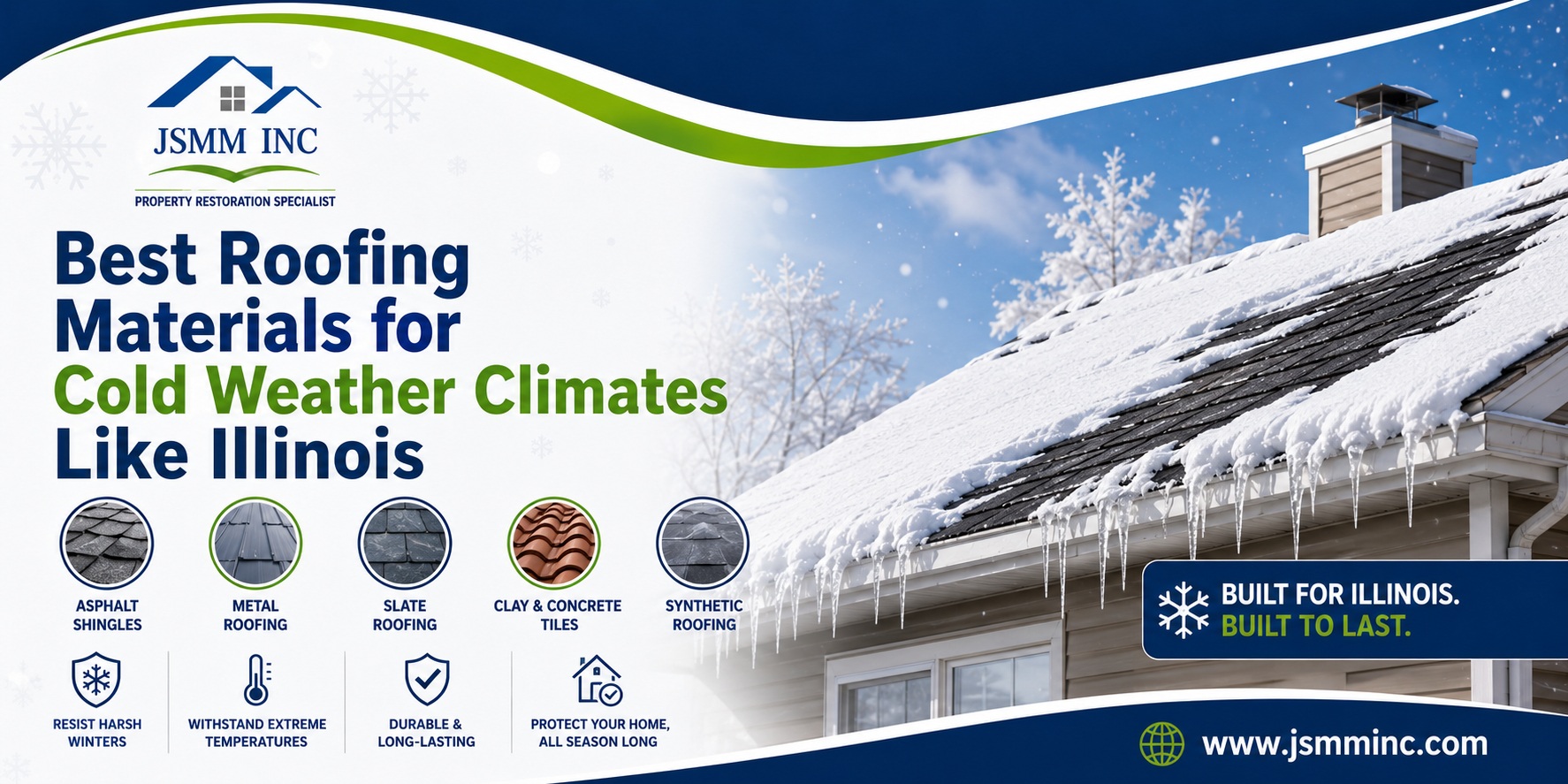
HOW EACH MATERIAL PERFORMS IN COLD WEATHER
Material by Material: Cold-Weather Performance
Architectural Asphalt Shingles
Architectural asphalt shingles are the most common residential roofing material in Illinois and perform well in cold weather when the right grade is selected.
High-quality architectural shingles maintain flexibility at low temperatures and resist cracking through freeze-thaw cycles. Cheap 3-tab shingles become brittle in cold and fail faster here.
For cold-weather performance in Illinois, look for shingles rated for Class 4 impact resistance and wind ratings of 110 mph or higher. These handle hail and wind better than standard grades.
Lifespan for quality architectural shingles in Illinois: 22 to 30 years with proper installation and ventilation.
Our detailed breakdown of asphalt shingle roof lifespan in Illinois covers what affects the lifespan specifically in cold-weather conditions.
Metal Roofing (Standing Seam)
Standing seam metal is one of the best performers in Illinois winters.
Metal expands and contracts without cracking because the seams float rather than being rigidly fastened. Snow sheds off the smooth surface readily, and freeze-thaw cycling does not degrade it.
Hail resistance is excellent. Class 4 impact ratings are standard for most commercial-grade metal roofing systems.
The main limitation is cost. The long lifespan of 40 to 60 years makes it more economical over time on properties where the owner plans to stay.
Our guide on picking the best roofing material for your home compares metal to composite options more broadly if you are weighing those two.
EPDM Rubber (Flat and Low-Slope Roofs)
EPDM rubber membrane is the best-performing flat roof material in Illinois winters.
Rubber remains flexible at low temperatures and does not crack through freeze-thaw cycles. This is why EPDM has dominated commercial flat roofing in cold climates for decades.
Snow accumulation is the main concern on flat roofs regardless of material. EPDM does not improve drainage, so the drainage design of the roof itself is critical in Illinois.
Lifespan: 20 to 30 years, sometimes longer with good maintenance and drainage management.
Slate and Slate-Alternative Materials
Natural slate is one of the most durable roofing materials in existence and performs well in cold climates.
It is dense, non-porous, and resists moisture absorption. Freeze-thaw cycling does not affect it the way it affects fibrous or composite materials. Lifespan can exceed 100 years on properly installed slate roofs.
The limitations are weight and cost. Slate requires a reinforced roof structure to carry the load. It is also among the most expensive materials to install and repair.
Synthetic slate alternatives made from rubber or polymer composites offer similar aesthetics at lower cost and weight, with good cold-weather performance and impact resistance ratings.
Wood Shakes
Wood shakes are not well suited to Illinois winters and are not recommended for the North Shore region.
Wood absorbs moisture in wet and freeze-thaw conditions. Repeated cycles of saturation and freezing cause splitting and warping. Moss and algae growth accelerates in humid North Shore seasons.
Many insurance companies have also tightened coverage terms for wood shake roofs in hail-prone regions. This limits their practical usefulness on Illinois properties regardless of aesthetic preference.
TPO and Modified Bitumen (Commercial)
TPO performs well in heat but is more sensitive to repeated cold exposure than EPDM.
Seam quality matters even more in cold climates because thermal contraction stresses the welded seams in ways that poorly done installations cannot handle long-term.
Modified bitumen is a more cold-weather-tolerant alternative to traditional BUR systems and is used on commercial low-slope roofs where membrane flexibility in cold temperatures is a priority.
The full comparison of commercial membrane options is covered in our guide on commercial roofing materials: TPO, EPDM, and metal which goes deep on how each performs across Illinois conditions.
WHAT TO CHOOSE FOR YOUR ILLINOIS HOME
Making the Right Call for Your Property and Climate
For Most Residential Roofs in Illinois
Quality architectural asphalt shingles with a Class 4 impact rating are the right choice for most Illinois homes.
They handle freeze-thaw, ice dam risk, and hail season better than standard grades. They are widely available, cost-effective, and supported by long manufacturer warranties.
The critical decision is grade. Do not select the cheapest option just because asphalt is a familiar material. The performance gap between entry-level and premium asphalt is significant in a cold climate.
For Long-Term Investment Properties
EPDM rubber is the most reliable membrane for flat roof sections in Illinois.
Its flexibility in cold temperatures makes it significantly more durable through freeze-thaw cycles than rigid or semi-rigid alternatives.
What Matters Beyond Material Choice
Even the best cold-weather material fails early if installed incorrectly.
Ice and water shield must be installed at the eaves, valleys, and penetrations. Attic ventilation must allow proper airflow to prevent ice dam formation. Flashing must be sealed correctly at every joint.
Our residential roof installation services in Illinois cover all of these installation requirements as standard practice, not optional add-ons.
When you are ready to move forward, visit our roofing company Highland Park page to learn more about our credentials and North Shore service area, or contact us for a free inspection and material recommendation.
Quick Tip Impact Rating Matters More in Illinois Than Most States
Illinois sits in one of the most hail-active corridors in the United States. Choosing a Class 4 impact-rated shingle or metal roof is not just a performance decision. Many Illinois homeowners qualify for insurance premium discounts when they install Class 4 rated materials. Ask your insurer before selecting your material. The discount can significantly offset the cost difference between standard and impact-rated options.
Frequently Asked Questions
What is the best roofing material for Illinois winters?
Class 4 impact-rated architectural asphalt shingles for most residential roofs. Standing seam metal for long-term investment properties. EPDM rubber for flat or low-slope sections.
Does cold weather shorten roof lifespan in Illinois?
Yes, compared to milder climates. Freeze-thaw cycling, ice dam risk, and heavy hail seasons accelerate wear on lower-grade materials. Choosing the right grade significantly extends lifespan.
Are wood shakes a good choice for Illinois homes?
No. Wood shakes absorb moisture and split through freeze-thaw cycles. They are not recommended for the North Shore region and may face stricter insurance terms in hail-prone areas.
Can I get an insurance discount for impact-resistant roofing?
Many Illinois insurers offer premium discounts for Class 4 impact-rated roofing materials. Check with your insurer before selecting materials, as the discount can offset part of the price difference.
Does JSMM-INC replace roofs in Lake Forest?
Yes. JSMM-INC provides free inspections and material recommendations for residential and commercial properties across Highland Park, Northbrook, Glenview, and the wider North Shore.
- Licensed Illinois contractor — License #104.019924
- BBB A+ rated with 5.0/5 customer satisfaction
- 24/7 emergency repair response
- Free on-site diagnostic inspection
- Full insurance documentation and claim management
Also serving: Northbrook roof repair, Glenview roof repair, Winnetka roof repair, and Lake Forest roof repair.
Get It Looked At — Before It Gets Bigger
JSMM Inc. has been handling commercial roof leak detection and repair across the North Shore and greater Chicago area for over 30 years. We offer free inspections and can typically get to an active situation within 24 hours.
Contact us here or call (847) 410-7060 — we’re available around the clock for emergencies. Our office is at 1542 Old Skokie Valley Rd, Highland Park, IL 60035.
Don’t just take our word for it — check out what our customers are saying.” → Link text: Read our Google reviews
About the Author
Janathan is a licensed roofing repair specialist at JSMM Inc with decades of field experience in residential and commercial roofing across Illinois. He leads the company’s diagnostic inspection process and storm damage documentation program.