

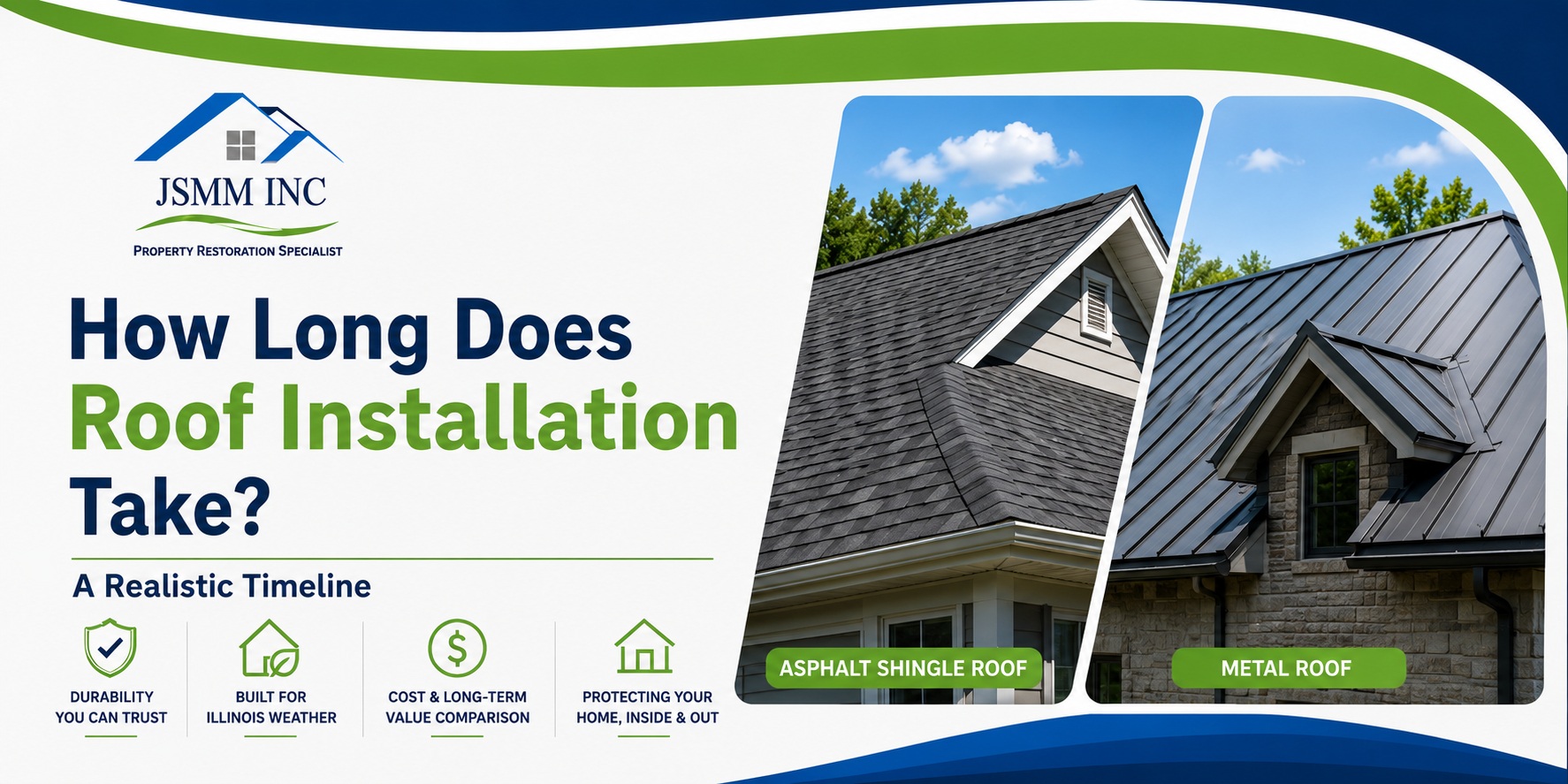
One of the first questions homeowners ask when planning a new roof is how long it will take.The answer is not one number. It depends on the size of your roof, the material being installed, the time of year, and whether any unexpected problems come up once the old roof is removed.This guide gives you realistic timelines for residential and commercial roof installations in Illinois, and explains exactly what drives the schedule.
Serving Highland Park, Northbrook, and Glenview, IL. Contact Us Today |
Table of Contents
TogglePART 1 OF 3| — THE INSTALLATION PHASES AND HOW LONG EACH TAKES
What Actually Happens— and When
PHASE 01 Scheduling and Materials Lead Time Once you sign a contract, the contractor orders your materials and secures a crew. Shingle orders for standard colors are usually fulfilled within a few days. Custom colors or premium shingles can take one to two weeks. During busy season in Illinois, typically spring through early fall, crew availability can push the start date by one to two additional weeks. This phase is not visible to you but it is part of the full timeline. A contractor who can start the next day without preparation is a red flag. |
PHASE02 Tear-Off:Removing the Old Roof Typical duration: Half a day to 1 full day On most residential roofs, the existing shingles are stripped down to the deck before any new material goes on. A crew of three to five workers can strip a standard single-story residential roof in half a day. Larger roofs, steep pitches, or multiple shingle layers take longer. Some roofs with two or more existing layers require additional time and disposal costs. Our residential roof installation services in Illinois always include a tear-off assessment before scheduling so there are no surprises on installation day. |
PHASE 03 Deck Inspection and Repairs Typical duration: A few hours to 1 full day (if repairs needed) Once the old roof is off, the deck is inspected for rot, soft spots, and damaged boards. If the deck is solid, the crew moves straight to installation. If repairs are needed, the work happens the same day in most cases. Deck repairs add time and cost that are not always predictable before tear-off begins. A good contractor will identify likely problem areas during the initial inspection and give you a conditional estimate. Understanding what inspectors look for on the deck can help you prepare. Our guide on the roof inspection checklist for professional inspectors covers what gets checked and why it matters. |
PHASE04 Installation: Underlayment, Shingles, and Flashing Typical duration: 1 to 2 days for residential / 3 to 7 days for commercial Underlayment goes down first across the entire deck, followed by the drip edge,then shingles installed from the bottom edge upward. Flashing is installed around every penetration: chimneys, vents, skylights,and valleys. This is the most detail-intensive part of the process and should not be rushed. A standard residential roof of 1,500 to 2,500 square feet takes one day for a full crew under good conditions. Roofs with steep pitches, multiple valleys, dormers, or skylights take longer. A complex residential roof can take two full days. |
PHASE 05 Cleanup and Final Walkthrough Typical duration: 2 to 4 hours After installation, the crew does a magnetic sweep of the property to collect nails, loads debris into the dumpster, and clears the gutters. The contractor walks the completed roof with you to review the work, point out any areas of note, and confirm everything meets the agreed scope. Before this walkthrough happens, it helps to know what to look for. Our guide on common mistakes during roof installationtells you what to check so you can ask the right questions on the day. |
Serving Highland Park, Northbrook, and Glenview, IL. Contact Us Today |
PART 2 OF 3 | WHAT MAKES A ROOF TAKE LONGER IN ILLINOIS
Six Factors That Affect Your Timeline
FACTOR 01 Roof Size and Complexity A simple gable roof on a ranch-style home installs faster than a hip roof with multiple valleys and dormers. Every additional feature adds time: each valley requires hand-cutting, each penetration needs custom flashing, and each slope change requires extra attention at the transition. |
FACTOR 02 Illinois Weather Windows Roofing cannot happen in rain, heavy wind, or temperatures below 40 degrees Fahrenheit. Most asphalt shingles require a minimum temperature for the adhesive strips to seal properly. Cold-weather installations can be done with special techniques but add complexity. Spring and early summer are the most reliable scheduling windows in Illinois. Fall is possible but weather uncertainty increases after October. |
FACTOR 03 Number of Shingle Layers Being Removed Illinois building codes allow a maximum of two shingle layers on most residential roofs. If your roof already has two layers, both must come off before new shingles go down. That adds half a day to a full day of tear-off time and increases disposal costs. |
FACTOR 04 Roofing Material Asphalt shingles install faster than any other residential material. Metal roofing takes longer because panels are custom cut and standing seam systems require precision fitting. A metal roof on the same house can take two to three times as long as asphalt. |
FACTOR 05 Permit Processing Time Some Illinois municipalities require a permit before installation begins. Permit processing typically takes three to seven business days. Your contractor should handle this before scheduling the crew. Skipping permits creates problems at resale and can affect insurance claims. Our guide on biggest mistakes homeowners make during roof replacement covers this and other avoidable errors in full detail. |
FACTOR 06 Commercial Roof Size and System Type Commercial flat roofs take significantly longer than residential linstallations because of scale and the complexity of membrane welding, drain installation, and penetration sealing. A small commercial building of 5,000 to 10,000 square feet typically takes three to five days. Larger properties can run one to two weeks. Our commercial roof installation team in Illinois provides a project-specific timeline before work begins so you can plan around the schedule. |
PART 3 OF 3 | — FULL TIMELINE SUMMARY AND PLANNING TIPS
What to Expect fromStart to Finish
Residential Roof Installation: Full Timeline
For a typical residential roof in Illinois, the full timeline from contract signing to project completion runs 2 to 4 weeks.
Most of that time is scheduling and materials lead time. The physical installation itself takes 1 to 2 days.
Materials are ordered and the crew is scheduled within the first few days after signing. Installation typically happens 10 to 21 days later and is completed in 1 to 2 days.
Commercial Roof Installation: Full Timeline
Commercial projects take longer at every stage.
Materials for specialty membrane systems like TPO or EPDM may require one to two weeks to arrive. The installation itself runs 3 to 7 days for most mid-size commercial roofs.
Total timeline from contract to completion for a commercial project is typically 3 to 6 weeks.
If your commercial roof is at end of life, our commercial roof replacement services in Illinois include a pre-project assessment and a written timeline before any work begins.
How to Prepare for Your Installation Day
Clear vehicles from the driveway the night before. The crew needs access for the dumpster and materials delivery early in the morning.
Let your neighbors know if you share a driveway or fence line. Roof installation generates noise from early morning.
Keep children and pets inside on installation day. Falling debris and loose nails are genuine hazards around the work area.
Also review our guide on the biggest mistakes homeowners make during roof replacement before the crew arrives. Knowing what to watch for makes the experience easier and protects your investment.
Get an Accurate Timeline for Your Specific Project
The only way to get a timeline that applies to your property is to have a contractor assess your roof in person.
JSMM-INC serves Highland Park, Northbrook, Glenview, and the wider North Shore. Visit our roofing company Highland Park page or contact us directly to schedule a free assessment and get a realistic timeline for your project.
Quick Tip Book Before Spring Rush, Not During It The busiest period for roofing in Illinois is May through August. Contractors are booked weeks out and material lead times stretch longer. If your roof needs replacing, getting on a contractor’s schedule in March or April typically means faster service, better crew availability, and sometimes lower pricing before peak season pricing kicks in. |
Frequently Asked Questions
Can a roof be installed in one day?
Yes. A standard residential roof of 1,500 to 2,500 square feet can be fully installed in one day by an experienced crew under good weather conditions.
What happens if it rains during installation?
Work stops until conditions improve. Your roof deck will be covered with underlayment before shingles go on, which provides temporary weather protection if rain interrupts the schedule.
How far in advance should I schedule a new roof?
Two to four weeks in slower seasons, four to six weeks during the spring and summer peak. Scheduling early avoids delays and gives you better contractor availability.
Does JSMM-INC provide a timeline before starting work?
Yes.Every JSMM-INC project includes a written schedule with phase dates so you know exactly what to expect before the crew arrives.
Does cold weather affect roof installation in Illinois?
Yes. Asphalt shingles require temperatures above 40 degrees to seal properly. Winter installations are possible with special techniques but are slower and require experienced crews.
- Licensed Illinois contractor — License #104.019924
- BBB A+ rated with 5.0/5 customer satisfaction
- 24/7 emergency repair response
- Free on-site diagnostic inspection
- Full insurance documentation and claim management
Also serving: Northbrook roof repair, Glenview roof repair, Winnetka roof repair, and Lake Forest roof repair.
Get It Looked At — Before It Gets Bigger
JSMM Inc. has been handling commercial roof leak detection and repair across the North Shore and greater Chicago area for over 30 years. We offer free inspections and can typically get to an active situation within 24 hours.
Contact us here or call (847) 410-7060 — we’re available around the clock for emergencies. Our office is at 1542 Old Skokie Valley Rd, Highland Park, IL 60035.
Don’t just take our word for it — check out what our customers are saying.” → Link text: Read our Google reviews
About the Author
Janathan is a licensed roofing repair specialist at JSMM Inc with decades of field experience in residential and commercial roofing across Illinois. He leads the company’s diagnostic inspection process and storm damage documentation program.